Samsung Galaxy S8 vs Huawei Mate 10 Pro: Battery Decides It

Table of Contents
TL;DR
Samsung Galaxy S8 vs Huawei Mate 10 Pro is a clear split: buy the Galaxy S8 for its 570 ppi screen and IP68 rating, or the Mate 10 Pro for its 4,000 mAh battery and 22.5W charging. The Galaxy S8 has 3,000 mAh and 15W, while the Mate 10 Pro has 402 ppi and IP67.
Galaxy S8
- Pick it if you read small text on screen, since the Galaxy S8 has 570 ppi.
- Skip it if storage space comes first, as the Mate 10 Pro offers 64GB and 128GB and the Galaxy S8 64GB.
Mate 10 Pro
- Pick it if storage space comes first, and the Mate 10 Pro offers 64GB and 128GB against the Galaxy S8 and its 64GB.
- Skip it if you need a memory card slot, since the Galaxy S8 has a card slot supported.
Samsung Galaxy S8 vs Huawei Mate 10 Pro specs: key differences
| Feature | Galaxy S8 | Mate 10 Pro |
|---|---|---|
| Water and dust resistance | IP68 | IP67 |
| Software | Android 7.0, upgradable to 9.0, One UI | Android 8.0, upgradable to 10, EMUI 10.2 |
| Wired charging | 15W wired | 22.5W wired |
| Weight | 155 g | 178 g |
| Display panel | Super AMOLED | OLED |
| Card slot | Yes | No card slot |
| Screen protection | Corning Gorilla Glass 5 | Corning Gorilla Glass (unspecified version) |
| USB | USB Type-C 3.1 | OTG, USB Type-C 3.1 |
Same on both: 12 MP main camera, 8 MP selfie camera, 2 × Nano-SIM, dual-band Wi-Fi 5, NFC.
Samsung Galaxy S8 vs Huawei Mate 10 Pro design and build compared
The Mate 10 Pro is the heavier phone at 178 g, 23 g more than the Galaxy S8 at 155 g. The Galaxy S8 body is 148.9 x 68.1 x 8 mm, while the Mate 10 Pro body is 154.2 x 74.5 x 7.9 mm. The Galaxy S8 comes in 7 colours, including Midnight Black, Orchid Gray and Arctic Silver, and the Mate 10 Pro in Midnight Blue, Titanium Gray, Mocha Brown and Pink Gold.
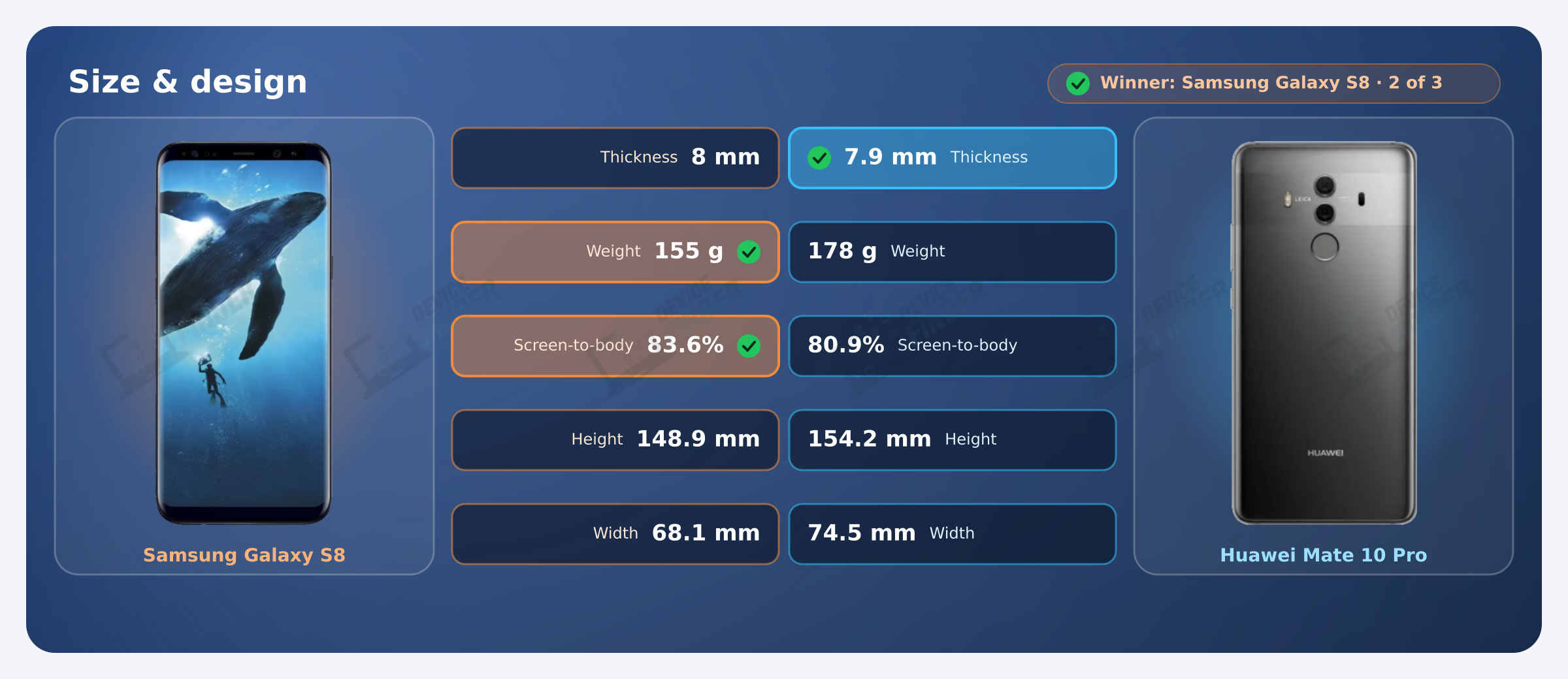
The Galaxy S8 has a screen-to-body ratio of 83.6%, while the Mate 10 Pro has 80.9%, so it suits buyers who want a narrower body around the screen. The Galaxy S8 is 148.9 mm tall and 68.1 mm wide, while the Mate 10 Pro is 154.2 mm tall and 74.5 mm wide, so the Galaxy S8 suits buyers who want a narrower body. The Mate 10 Pro is only 7.9 mm thick, while the Galaxy S8 is 8 mm.
15% is the weight gap, with the Mate 10 Pro the heavier phone, so buyers who want less weight in a pocket or bag should look at the Galaxy S8. The colour lists differ, so buyers who want a wider choice suit the Galaxy S8.
Nano-SIM or 2 × Nano-SIM is the SIM setup on both phones, so either suits buyers who carry two SIM cards. Both phones list no FM radio, so neither suits buyers who rely on it. Each phone has a rear-mounted fingerprint sensor.
Glass, aluminium and water resistance on both phones
The frame is aluminum on both phones. The Galaxy S8 carries an IP68 rating, while the Mate 10 Pro carries IP67. For the back, the Galaxy S8 uses Gorilla Glass 5 and the Mate 10 Pro glass.
Buyers who want a named glass version on both sides get that on the Galaxy S8.
Ports, audio and connectivity on Galaxy S8 and Mate 10 Pro
Each phone connects over 802.11ac and has a USB 3.1 port. The Galaxy S8 has Bluetooth 5.0, and the Mate 10 Pro Bluetooth 4.2. Each phone supports NFC.
Display: the Galaxy S8 and Mate 10 Pro screens side by side
The Galaxy S8 screen is 5.8 inches across, and the Mate 10 Pro screen 6 inches. The Galaxy S8 displays 1440 x 2960 pixels, and the Mate 10 Pro 1080 x 2160 pixels. The Galaxy S8 screen has a pixel density of 570 ppi, and the Mate 10 Pro screen 402 ppi.
The Galaxy S8 screen is Super AMOLED, and the Mate 10 Pro screen is OLED. Glass on the Galaxy S8 display is Corning Gorilla Glass 5, while on the Mate 10 Pro display it is Corning Gorilla Glass (unspecified version).
168 ppi is the density gap, with the Galaxy S8 on the higher side, so it suits buyers who read small text or look at photos closely.
0.2 inches separates the two screens, so the size choice is small. The Galaxy S8 aspect ratio is 18.5:9, while the Mate 10 Pro is 18:9.
HDR10 is listed on both phones, so HDR video support does not split them. The Galaxy S8 adds 3D Touch (home button only), which is a small extra.
Performance, RAM and software on the Galaxy S8 and Mate 10 Pro
The Galaxy S8 has the EMEA: Exynos 8895 · USA & China: Snapdragon 835 (MSM8998) and the Mate 10 Pro has the Kirin 970.
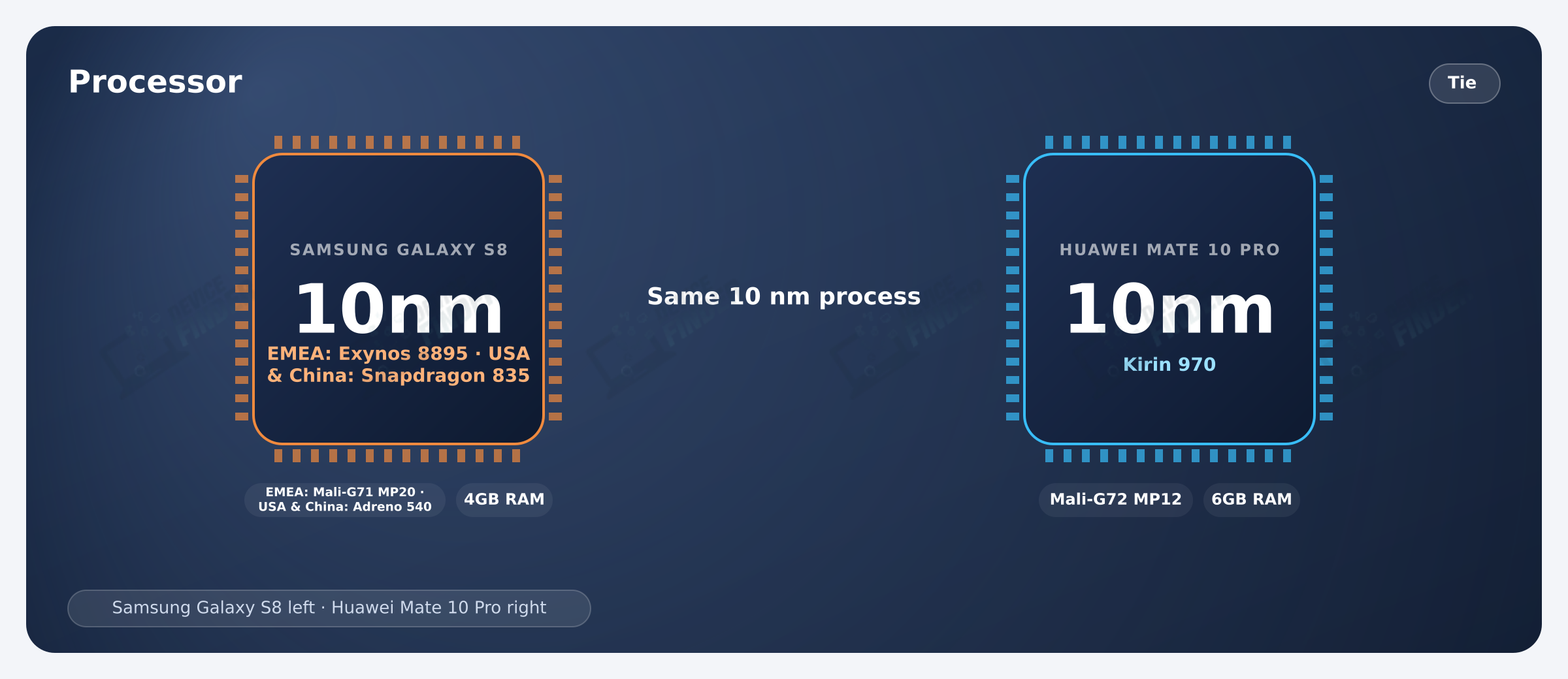
10 nm is the process node of both chips, and both phones have 8 CPU cores, so the two tie on chip. Everyday speed should sit close for most buyers, so the chip is not the reason to pick one.
The Mate 10 Pro wins on RAM, so buyers who keep many apps open should look at its 128GB version with 6GB RAM. The Mate 10 Pro has 2 storage and RAM versions to choose from.
Discontinued is the status of both phones, so availability depends on remaining stock. Huawei Mate 10 Pro launched in October 2017, 7 months after Samsung Galaxy S8 (March 2017), which makes it the newer phone. Buyers should weigh that age gap against the battery and RAM gains.
Exynos and Kirin chipsets compared
On AnTuTu, the Galaxy S8 posts 199,022 (v7).
The Mate 10 Pro has 4 cores at 2.4 GHz and 4 cores at 1.8 GHz, with a 2.4 GHz top clock. Buyers should check which regional version of the Galaxy S8 they are getting.
6,656 (v4.4) is the Galaxy S8 Geekbench score, while the Mate 10 Pro scores 6,783 (v4.4). The scores sit close, which fits the tie on chip. Buyers should not choose between these phones on the chip.
Mate 10 Pro offers more RAM for multitasking
The Galaxy S8 offers 4GB of RAM, while the Mate 10 Pro offers 4GB or 6GB.
4GB and 6GB RAM options give the Mate 10 Pro buyers a choice, while the Galaxy S8 comes with 4GB RAM only.
Android versions and software on both phones
The Galaxy S8 uses One UI as its interface, while the Mate 10 Pro uses EMUI 10.2.
Android 7.0 at launch on the Galaxy S8 is upgradable to 9.0, while the Mate 10 Pro launched with Android 8.0 and is upgradable to 10.
Gaming on the Samsung Galaxy S8 and Huawei Mate 10 Pro
Games on the Galaxy S8 draw on the EMEA: Mali-G71 MP20 · USA & China: Adreno 540, while the Mate 10 Pro draws on the Mali-G72 MP12.
| Game | Galaxy S8 | Mate 10 Pro |
|---|---|---|
| Call of Duty: Mobile | Medium graphics | Medium |
| Asphalt Legends (Unite) | Medium quality | Medium |
| Clash Royale | Default (High) | High |
| Roblox | Graphics level 5–6 | Medium |
| Minecraft (Bedrock) | Fancy graphics, 10-chunk render distance | High |
| Free Fire | Smooth to Standard | High |
| Free Fire MAX | Smooth | Medium |
| PUBG Mobile | Smooth graphics | Balanced |
| BGMI | Smooth graphics | Balanced |
The graphics presets and target FPS are estimates from each phone's chipset class and refresh rate, not measured results.
10 nm chips sit in both phones and the two tie on chip, so game speed should stay close for most players. The Galaxy S8 GPU depends on region, so buyers should check which version they get. The Mate 10 Pro wins on RAM with up to 6GB, so it suits players who keep games and other apps open together.
Players who care about fine detail suit the Galaxy S8. Players who want a 6-inch screen suit the Mate 10 Pro, while the Galaxy S8 has a 5.8-inch screen.
- Ultra-Wide Camera Phone Guide: Specs to Check in Bangladesh09 November, 2026
- AI Cameras in Smartphones: What Works and What Is Hype09 November, 2026
- Snapdragon 8 Gen 3 AnTuTu Score and Value in Bangladesh 202609 November, 2026
- Snapdragon Processors List 2026: Ranking for Bangladesh Buyers09 November, 2026
- Mobile Processor Ranking 2026: Best Chips by Tier in Bangladesh09 November, 2026
- Android Phone in Bangladesh: Complete 2026 Buying Guide09 November, 2026





- Meta Puts Its Muse AI Agent Inside Instagram DMs and Saved Posts24 November, 2026
- Ted Lasso Will Return: Apple Confirms a Fifth Season on Apple TV24 November, 2026
- One UI 9.5 Stops Scammers From Talking You Out of Auto Blocker During Calls23 November, 2026
- Unconfirmed: Apple Tested a Complication Column for More Widgets on the iPhone Duo Lock Screen23 November, 2026
- Google Built a Fake Internet Called the Mirror Dimension to Train Chrome's AI Agents22 November, 2026
- Gemini on Mac Can Now Click, Type and Run Your Desktop Apps for You22 November, 2026





- Samsung Galaxy Phones 2025: Which One Fits Your Lifestyle?27 September, 2025
- Android 9: A Milestone in Android Evolution27 September, 2025
- OPPO A5: Power-Packed Phone with Long Battery27 September, 2025
- Nokia 2652 Foldable Launches After 1B Sales Milestone27 September, 2025
- Vivo OriginOS 6 Update: Features, Eligible Phones And Rollout Info25 September, 2025
- Upcoming iPhone: Are You Ready for the Next Revolution?25 September, 2025
Samsung Galaxy S8 vs Huawei Mate 10 Pro camera comparison
Both phones have 12 MP main cameras.
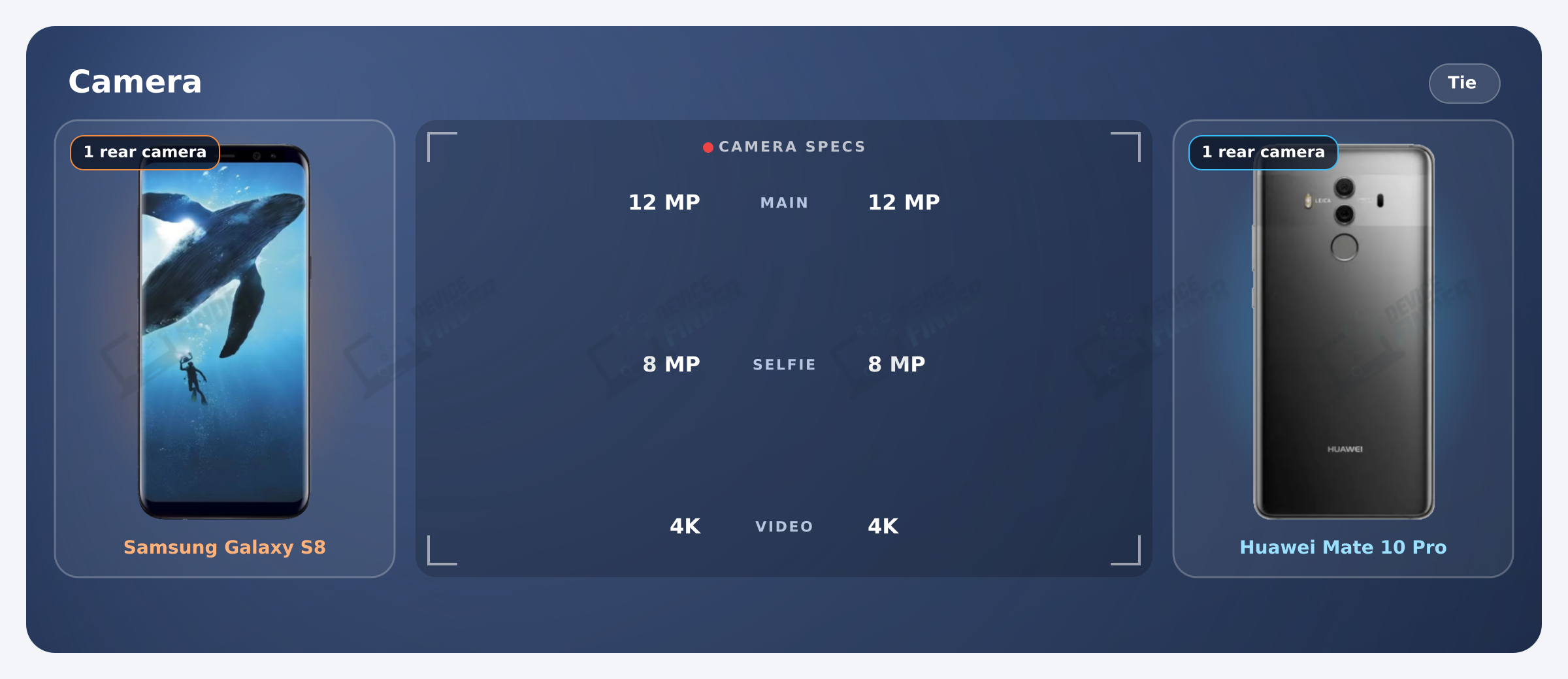
The two tie on camera, so neither main lens decides the choice alone.
The two tie on selfie. Either front camera suits casual social posts.
1080p at up to 60fps is a rear video mode on both phones. The Galaxy S8 adds 720p at up to 240fps for slow motion. The Galaxy S8 lists 720p at up to 240fps for slow motion, so it suits buyers who shoot slow-motion video.
Camera: one lens on the Galaxy S8, two on the Mate 10 Pro
The Mate 10 Pro adds a 20 MP monochrome to its main camera.
Buyers who like black and white photos suit the Mate 10 Pro with its 20 MP monochrome.
Video recording and selfies on both phones
The front camera on each phone is 8 MP. From the back, each phone goes up to 4K at 30fps for video. The Galaxy S8 records selfie video up to 1440p at 30fps, and the Mate 10 Pro up to 1080p at 30fps.
The Mate 10 Pro matches it on 4K at 30fps from the back. Selfie video is where the Galaxy S8 goes further, at 1440p against 1080p on the Mate 10 Pro, which suits buyers who film video calls and vlogs.
Samsung Galaxy S8 vs Huawei Mate 10 Pro battery: Huawei Mate 10 Pro brings the bigger battery and faster charging than Galaxy S8
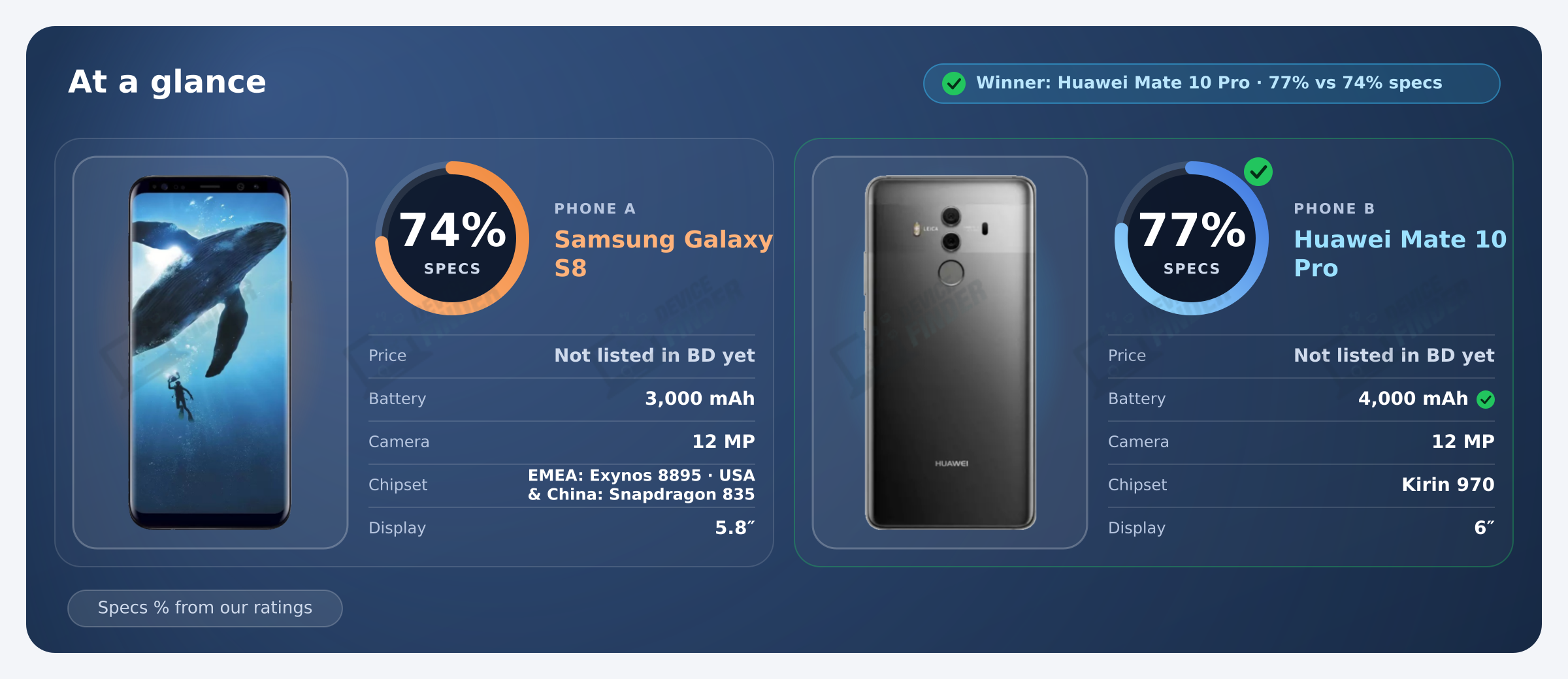
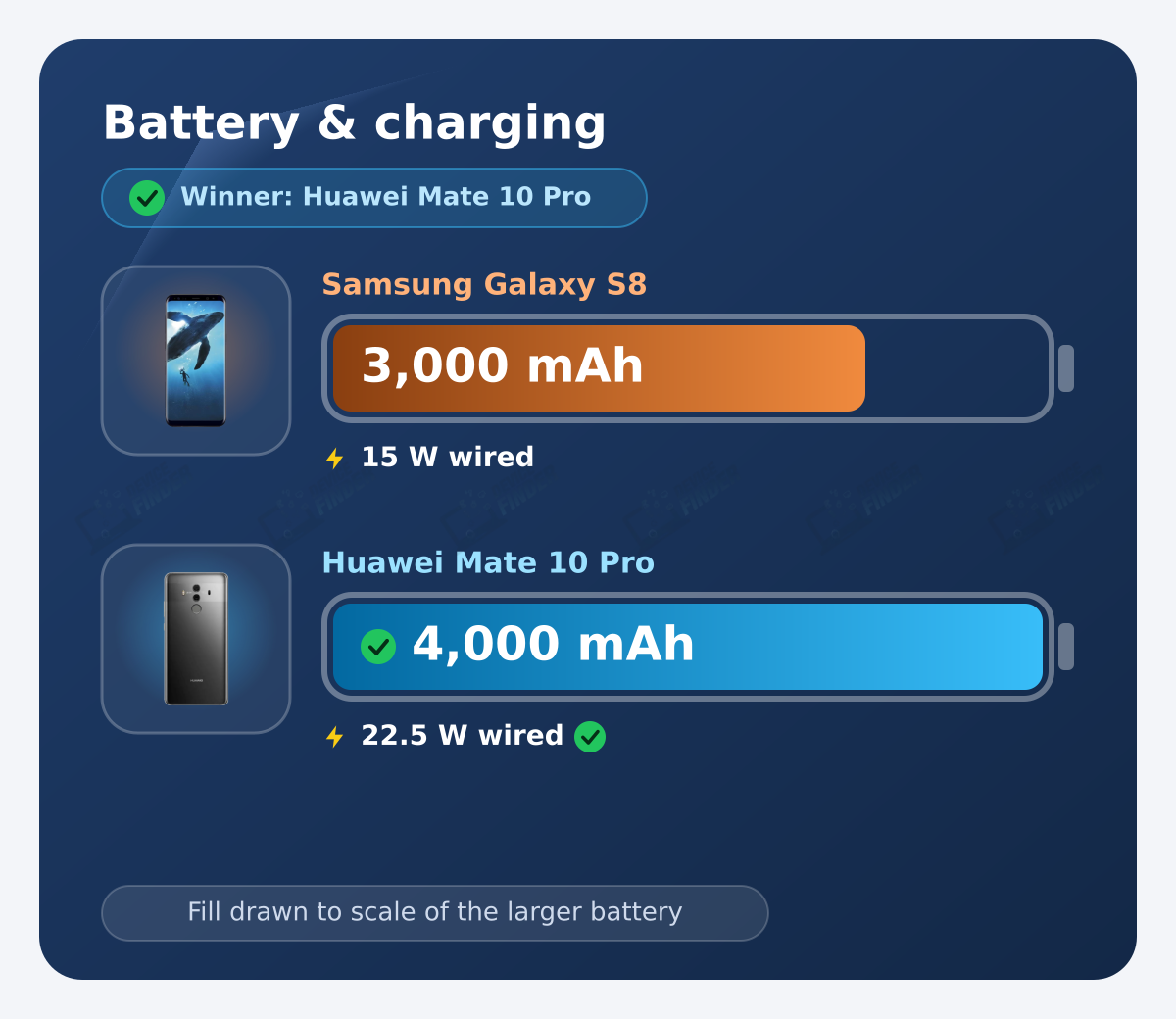
The Mate 10 Pro carries the bigger battery at 4,000 mAh, 1,000 mAh more than the Galaxy S8 at 3,000 mAh. On wired charging, the Mate 10 Pro supports 22.5W and the Galaxy S8 15W.
The Mate 10 Pro wins on battery, and its capacity is 33% above the Galaxy S8, so it suits buyers who want the bigger battery. The gap is also a reason to treat the Galaxy S8 as the phone that needs a charger sooner.
7.5W is the charging gap, with the Mate 10 Pro the faster, and the Mate 10 Pro wins on charging. The listed claim for the Mate 10 Pro is 58% in 30 minutes (22.5W wired). Buyers who top up between errands suit the Mate 10 Pro.
Value for money: what the Galaxy S8 and Mate 10 Pro give you
The Galaxy S8 is offered in 64GB storage, and the Mate 10 Pro in 64GB and 128GB.
64GB with 4GB RAM and 128GB with 6GB RAM are the two versions of the Mate 10 Pro, and the Mate 10 Pro wins on storage. The Galaxy S8 has the single 4 GB + 64 GB version.
Card slot supported on the Galaxy S8, while the Mate 10 Pro has no card slot, so Galaxy S8 buyers can add space later. Buyers who want the extra space fixed in the phone suit the Mate 10 Pro. The right pick depends on which route to more storage a buyer prefers.
Rear-mounted fingerprint sensors sit on both phones, so unlocking is similar. Buyers who ignore those extras can focus on the battery and storage gains of the Mate 10 Pro.
Mate 10 Pro wins on storage options
The Galaxy S8 uses UFS 2.0 or UFS 2.1 storage, and the Mate 10 Pro UFS 2.1 storage.
The Galaxy S8 answers with a card slot, while the Mate 10 Pro has no card slot. Buyers who already own a memory card suit the Galaxy S8.
Extras that set the Galaxy S8 apart
Iris scanner, heart rate and SpO2 are sensors listed on the Galaxy S8, while the Mate 10 Pro sensor list is fingerprint (rear-mounted), accelerometer, gyro, proximity, barometer and compass. Buyers who want health sensors or iris unlock suit the Galaxy S8.
Verdict: Galaxy S8 or Mate 10 Pro, which one to buy
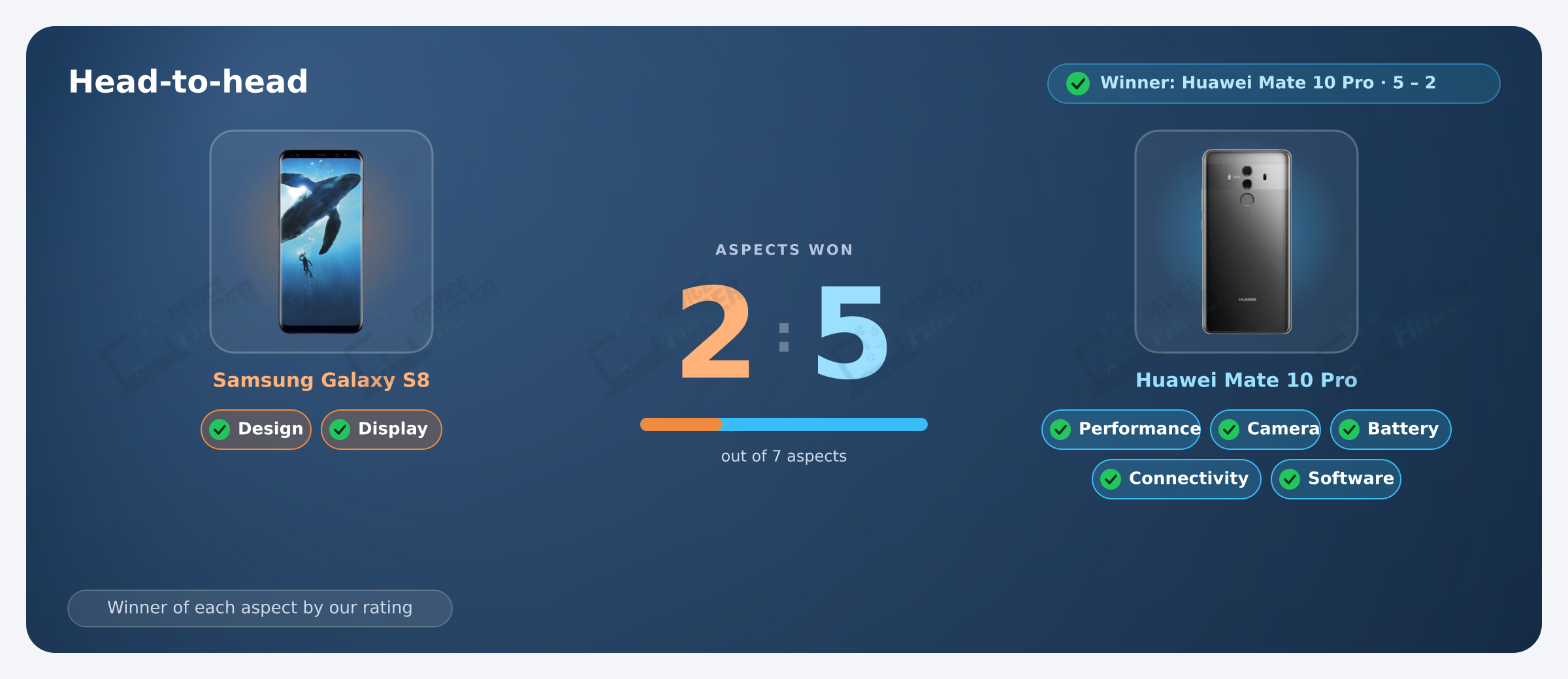
For most buyers in Bangladesh, choose the Mate 10 Pro: it has a 4,000 mAh battery, 22.5W wired charging and a 128GB storage option. The Galaxy S8 suits buyers who want a 570 ppi Super AMOLED screen, since the Mate 10 Pro has 402 ppi. The Mate 10 Pro gives buyers more capacity and quicker refills, which matter most to anyone who charges often.
Choosing the Galaxy S8 gives up charging speed, since it has 15W and 3,000 mAh.
Read the full review of each phone: Samsung Galaxy S8, Huawei Mate 10 Pro.
Related pages






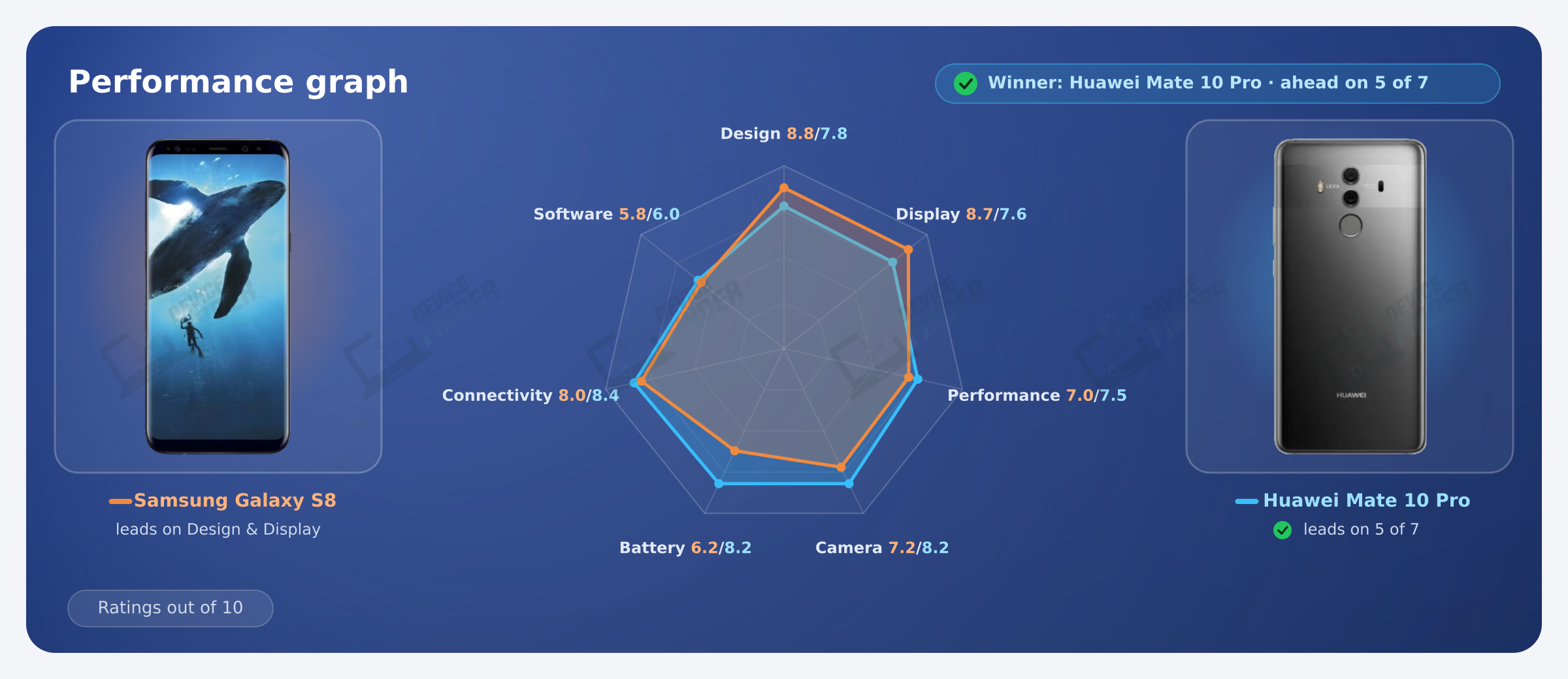
DevicesFinder.com Score: Galaxy S8 vs Mate 10 Pro
Each category is scored out of 10. The stronger colour marks the winner. Ties are shown with both bars in the strong colour.
Galaxy S8 vs Mate 10 Pro Specifications Comparison
 Galaxy S8Full specs
 Mate 10 ProFull specs
Display
General
Network
Additional Features
Audio
Battery
Benchmarks
Body
Connectivity
Front Camera
Main Camera
Memory
Performance
Platform
Sensors


- Samsung Galaxy S25 Ultra vs Apple iPhone 16 Pro Max
- Apple iPhone 13 Pro Max vs Apple iPhone 15 Pro Max
- Apple iPhone 13 Pro Max vs Apple iPhone 14 Pro Max
- Xiaomi Redmi 9A vs Realme C25
- Apple iPhone 16 Pro Max vs Apple iPhone 16 Pro
- Realme C25 vs Xiaomi Redmi 9
- Huawei Mate 60 Pro vs Apple iPhone 16 Pro Max
- Huawei P30 Pro vs Apple iPhone XS Max
- vivo Y27s vs Tecno Spark 20 Pro
- Realme 11 Pro vs Google Pixel 7a
- Xiaomi Redmi Note 13 Pro vs Samsung Galaxy A55
- Samsung Galaxy S25 vs Apple iPhone 15 Pro Max
- Xiaomi Redmi Note 15 Pro 5G vs Xiaomi Redmi Note 12 Pro
- Realme Narzo 50 5G vs Realme 9 Pro
- Infinix Zero 30 4G vs Tecno Spark 20 Pro
- Motorola Edge S vs Realme 10 Pro+
How I test
I compared both phones on their full specification sheets and their Geekbench scores side by side. No shop in Bangladesh lists a price for either phone, so there is no price comparison. The category winners in the text come from the values on those specification sheets.
Last updated
This is our own independent analysis and the author's view. Before buying any product, check its specifications, price, warranty and quality yourself. We do not guarantee that the information on this page is 100% accurate or up to date. Read more
Frequently asked questions
Which is better, the Galaxy S8 or the Mate 10 Pro?
Camera: one or both — how do the Samsung Galaxy S8's single camera and the Huawei Mate 10 Pro's dual cameras compare?
Which has the bigger battery, the Samsung Galaxy S8 or the Huawei Mate 10 Pro?
Does the Huawei Mate 10 Pro charge faster than the Samsung Galaxy S8?
Are the Samsung Galaxy S8 and Huawei Mate 10 Pro waterproof?
About the author

User Review for Comparison of Samsung Galaxy S8 vs Huawei Mate 10 Pro
Did this comparison help you choose? Rate it and tell other readers what decided it for you.


Latest Blog & News
 iOS 27.3 and macOS 27.3 Public Beta 2 Arrive With Siri AI Upgrades and New Safari Tabs
 iPhone Duo Gets Face Unlock in iOS 27.3 Beta, Plus Unconfirmed iPhone 20 Pro Rumours
 Google Is Shutting Down the Nest App and Replacing Assistant With Gemini on Speakers and Displays
 Unconfirmed: Samsung May Push Its Own Updates to Its Upcoming Android Laptops
 Unconfirmed Pixel 11 Pro XL Prototype Leak Shows Both a Temperature Sensor and HiLight