Infinix Zero 30 4G vs Tecno Spark 20 Pro: Zero Charges Faster

Table of Contents
TL;DR
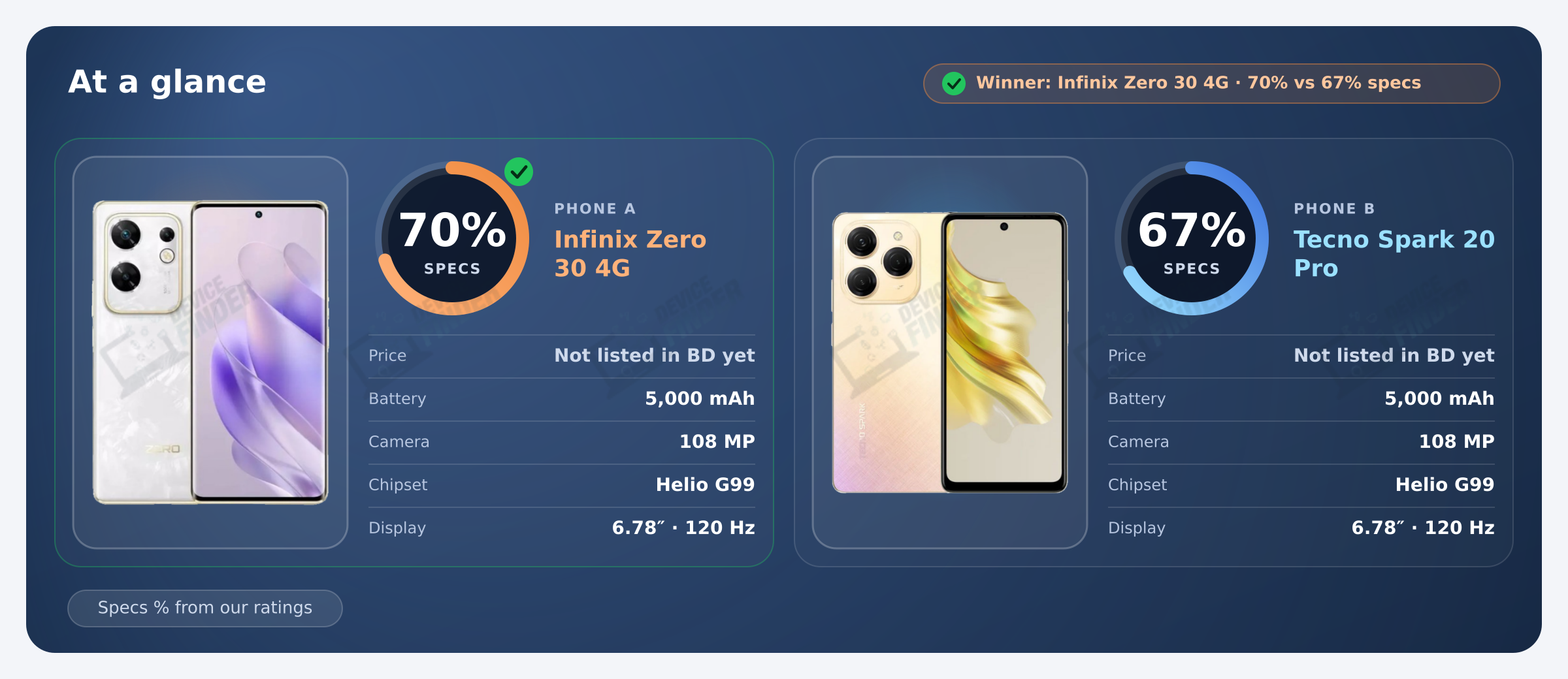
Infinix Zero 30 4G vs Tecno Spark 20 Pro is a clear split: buy the Zero 30 4G for the camera and faster charging, or the Spark 20 Pro for more RAM. The Zero 30 4G has 45W charging and a 50 MP selfie camera, while the Spark 20 Pro has 33W and 32 MP. Both hold 5,000 mAh.
Zero 30 4G
- Pick it if you want faster charging, since the Zero 30 4G has 45W wired charging.
Spark 20 Pro
- Pick it if you want a choice of RAM size, since the Spark 20 Pro comes with 4GB, 8GB or 12GB.
- Skip it if you want selfie quality, since the Zero 30 4G has a 50 MP selfie camera.
Infinix Zero 30 4G vs Tecno Spark 20 Pro specs: key differences
| Feature | Zero 30 4G | Spark 20 Pro |
|---|---|---|
| Water and dust resistance | IP54 | IP53 |
| Wired charging | 45W wired | 33W wired |
| Display panel | AMOLED | IPS LCD |
| Card slot | No card slot | Yes |
| USB | OTG, USB Type-C 2.0 | USB Type-C |
| 3.5mm jack | No | Yes |
| Loudspeaker | Dual speakers | Stereo speakers |
Same on both: Helio G99 chipset; 5,000 mAh battery; 108 MP main camera; 6.78-inch screen; 120 Hz refresh rate; Android 13; 2 × Nano-SIM; dual-band Wi-Fi 5.
Infinix Zero 30 4G and Tecno Spark 20 Pro design and build compared
The Zero 30 4G body is 164.5 x 75 x 7.9 mm, while the Spark 20 Pro body is 168.6 x 76.6 x 8.4 mm.
USB Type-C is the port on both phones. The Zero 30 4G adds USB 2.0 and OTG, so it suits buyers who plug in a flash drive. The Spark 20 Pro lists A2DP, LE for Bluetooth features.
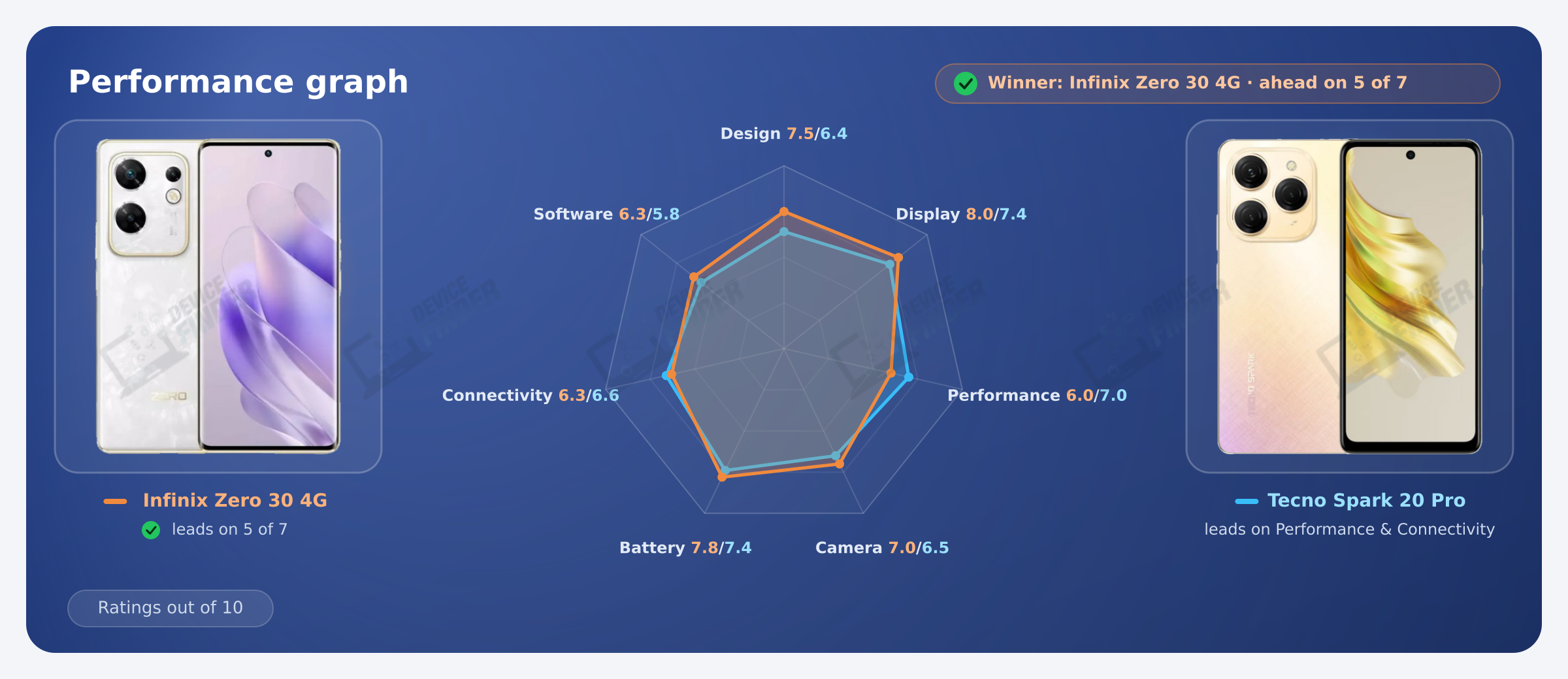
6.4 is the design rating of the Spark 20 Pro, and its connectivity rating is 6.6. Neither score is a spec, so the body and build details matter more for a buyer.
Size, weight and materials
7.9 mm is the thickness of the Zero 30 4G, while the Spark 20 Pro is 8.4 mm, so the Zero 30 4G is thinner. The Zero 30 4G weighs 182 g. The Spark 20 Pro has a glass front with a plastic back and a plastic frame.
Water and dust rating and colour options
For dust and water, the Zero 30 4G is rated IP54 and the Spark 20 Pro IP53. The Zero 30 4G is sold in Sunset Gold, Misty Green and Pearly White, while the Spark 20 Pro is sold in Moonlit Black, Frosty Ivory, Sunset Blush and Magic Skin 2.0 Green.
The Zero 30 4G has IP54 and the Spark 20 Pro has IP53, and both ratings are for dust and splash protection, not submersion, so both phones suit buyers who face only rain and splashes. Neither rating makes a phone waterproof.
Connectivity, audio and fingerprint sensors
Each phone supports 802.11ac. The two phones come with NFC.
2 × Nano-SIM is the SIM setup on both phones, and both have dual-band Wi-Fi. The Spark 20 Pro lists GPS, GLONASS, while the Zero 30 4G lists GPS.
The Zero 30 4G has dual speakers with 24-bit/192kHz Hi-Res audio, Tuned by JBL, and it has no 3.5mm headphone jack. The Spark 20 Pro has Stereo speakers and a 3.5mm headphone jack supported, so it suits buyers with wired earphones. Fingerprint (under display, optical) is the sensor on the Zero 30 4G, while the Spark 20 Pro has Fingerprint (side-mounted).
AMOLED on the Infinix Zero 30 4G against IPS LCD on the Tecno Spark 20 Pro
AMOLED is the panel on the Zero 30 4G, while the Spark 20 Pro has IPS LCD, so the panel is the real choice between them. Both screens are the same size and run at a high refresh rate.
90% is the screen-to-body ratio of the Zero 30 4G, while the Spark 20 Pro has 84.5%, so the Zero 30 4G suits buyers who want the screen to fill the front. The Zero 30 4G lists Corning Gorilla Glass 5 on its screen. The Spark 20 Pro screen sits behind the glass front noted above.
Display: the Zero 30 4G and Spark 20 Pro screens side by side
Both screens measure 6.78 inches. The Zero 30 4G screen has 1080 x 2400 pixels, and the Spark 20 Pro screen 1080 x 2460 pixels. The two phones each refresh at up to 120Hz.
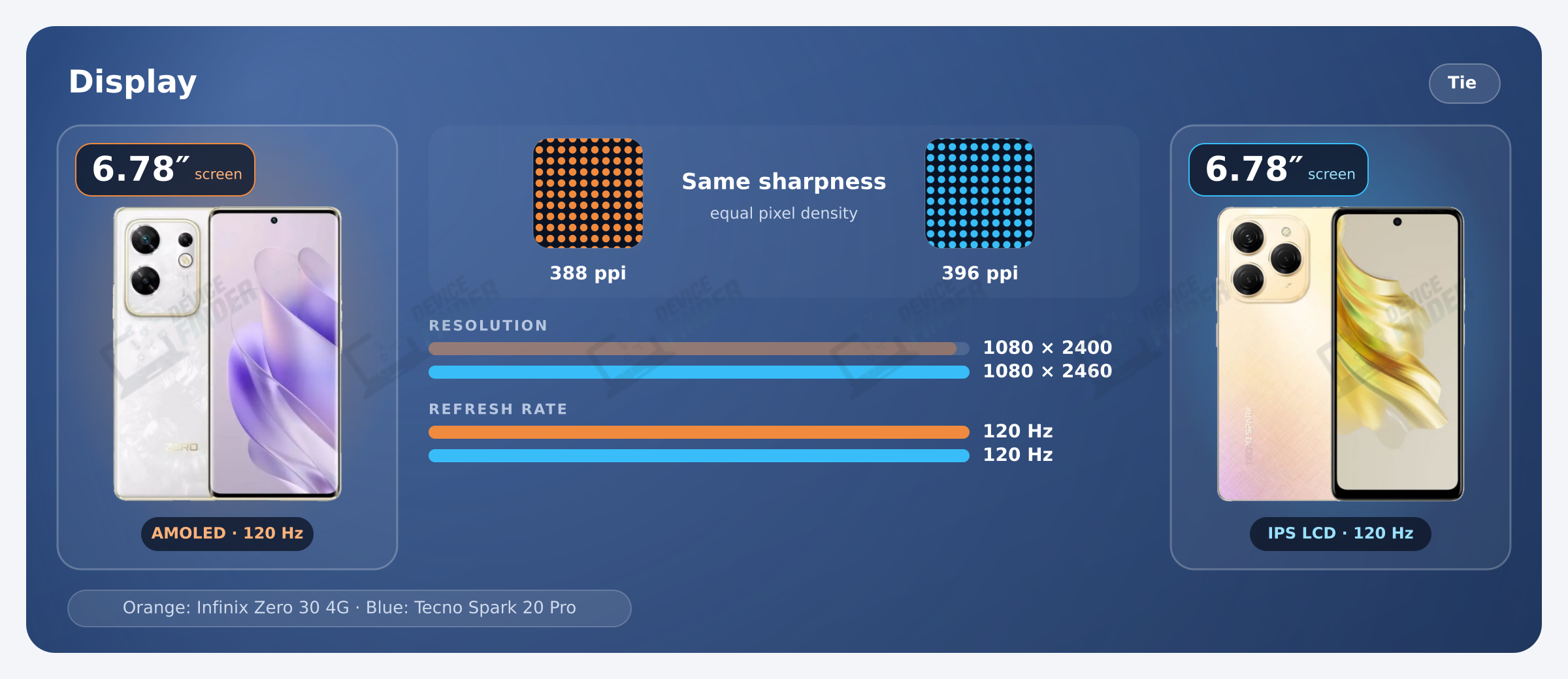
The Zero 30 4G screen has a pixel density of 388 ppi, and the Spark 20 Pro screen 396 ppi. For the panel, the Zero 30 4G uses AMOLED and the Spark 20 Pro uses IPS LCD.
The Zero 30 4G also lists 1B colors for its AMOLED panel.
20:9 is the aspect ratio of that screen, a tall shape for video and scrolling.
7.4 is the display rating of the Spark 20 Pro.
The same MediaTek chipset powers both phones
Both phones run on the 6 nm Helio G99.
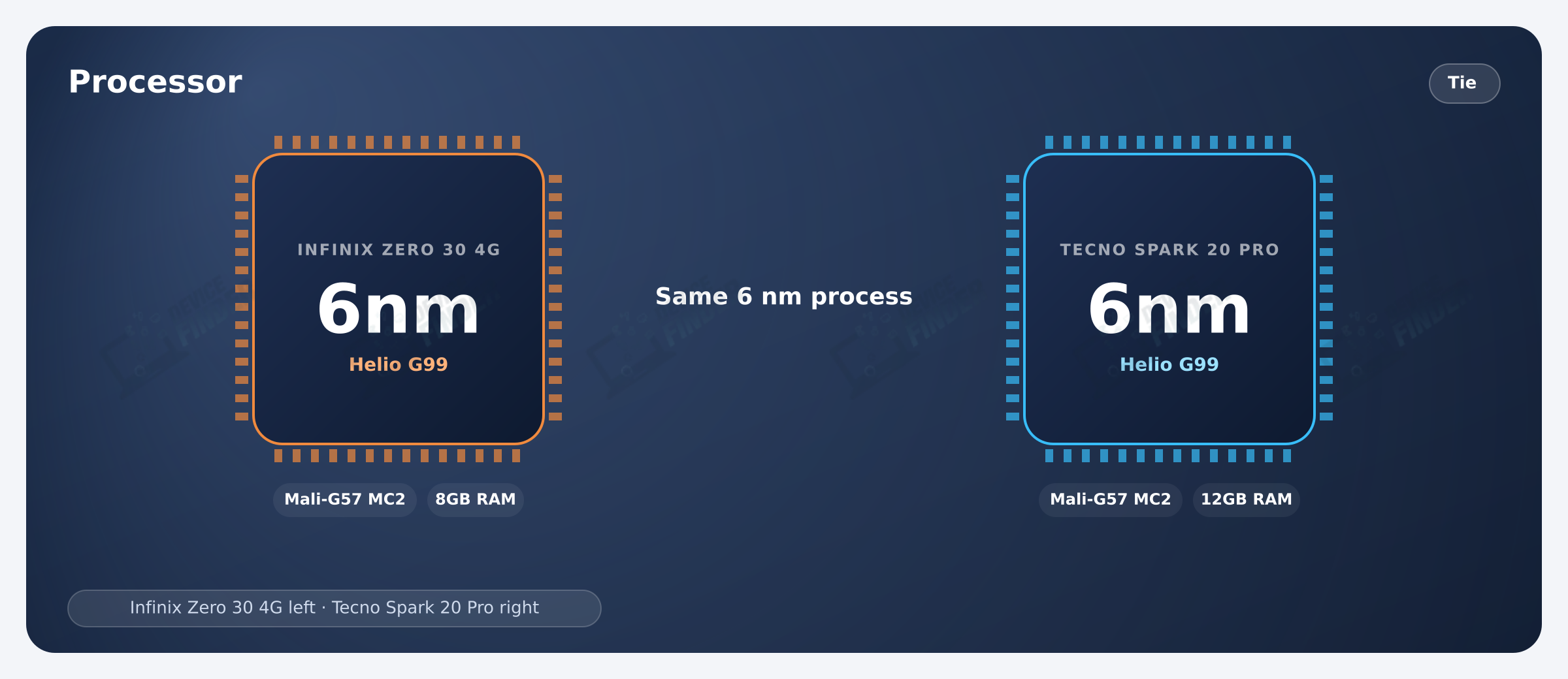
Helio G99 is the chip in both phones, and the two tie on chip. Both use 8 CPU cores, so buyers get the same processing from either. Chip speed will not decide this choice.
The Spark 20 Pro wins on RAM. The Zero 30 4G has 8GB RAM, which suits buyers who want one fixed version. The shared chip means RAM is the choice that matters for multitasking.
7.0 is the performance rating of the Spark 20 Pro, and its software rating is 5.8. The Spark 20 Pro has a performance rating of 7.0, which is a score card number and not a spec. Buyers should read them next to the shared Helio G99, which keeps the two phones level.
Processor and CPU layout
Both CPUs have 2 cores at 2.2 GHz and 6 cores at 2.0 GHz.
2.2 GHz is the top clock speed on both phones, and both CPUs are octa-core. Buyers therefore see no processor gap between the phones.
Tecno Spark 20 Pro leads on RAM options
The Zero 30 4G has 8GB of RAM and the Spark 20 Pro 4GB, 8GB or 12GB.
3 is the number of storage and RAM versions of the Spark 20 Pro, so buyers pick the RAM size they need.
Software at launch
Both phones launched on Android 13. The Zero 30 4G runs XOS 13.
Gaming on the Infinix Zero 30 4G and Tecno Spark 20 Pro
The graphics chip in each phone is the Mali-G57 MC2.
| Game | Zero 30 4G | Spark 20 Pro |
|---|---|---|
| Call of Duty: Mobile | Medium graphics · 60 fps | Medium graphics · 60 fps |
| Asphalt Legends (Unite) | Medium quality · 45 fps | Medium quality · 45 fps |
| Genshin Impact | Lowest · 30 fps | Lowest · 30 fps |
| Clash Royale | Default · 60 fps | Default · 60 fps |
| Roblox | Medium graphics · 60 fps | Medium graphics · 60 fps |
| Minecraft (Bedrock) | Medium, fancy graphics off · 60 fps | Medium, fancy graphics off · 60 fps |
| Free Fire | Ultra · 90 fps | Ultra · 90 fps |
| Free Fire MAX | High · 90 fps | High · 90 fps |
| PUBG Mobile | Balanced · 60 fps | Balanced · 60 fps |
| BGMI | Balanced · 45 fps | Balanced · 45 fps |
The graphics presets and target FPS are estimates from each phone's chipset class and refresh rate, not measured results. Both phones are estimated at the same presets and target FPS in every game listed.
Helio G99 sits in both phones, so the chip and CPU do not separate them for games. Both screens refresh at a rate that helps games that support it.
AMOLED is the panel on the Zero 30 4G, which suits buyers who play outdoors, given its peak brightness. The Spark 20 Pro has a 6.78-inch IPS LCD screen with a 120Hz refresh rate, which suits buyers who want a large screen for games. The Spark 20 Pro has a 3.5mm headphone jack, so it suits gamers who play with wired headphones, while the Zero 30 4G has no 3.5mm headphone jack.
RAM is where the Spark 20 Pro has the edge, so gamers who keep many apps open should look at its largest version.
Infinix Zero 30 4G vs Tecno Spark 20 Pro camera: Infinix Zero 30 4G wins on cameras
The main rear camera on each phone is 108 MP.
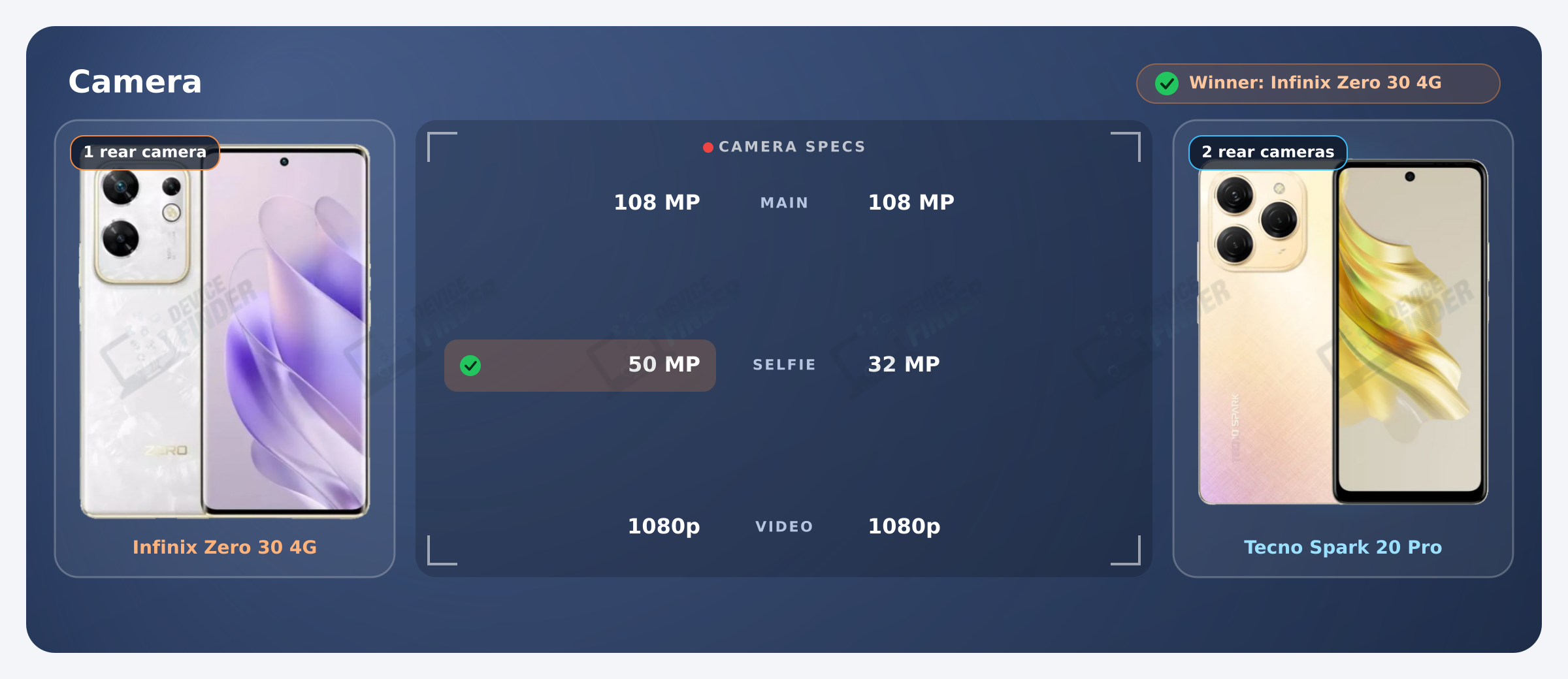
Buyers who shoot wide scenes get a panorama mode on the Zero 30 4G.
1080p at up to 60fps is the extra rear video mode of the Zero 30 4G, while the Spark 20 Pro lists 1080p at up to 30fps. The top rear mode is the same on both phones.
6.5 is the camera rating of the Spark 20 Pro, the score card's own number. The camera win for the Zero 30 4G rests on lens and selfie specs, not on that score. The Spark 20 Pro still suits buyers who want a simple set with one close-up lens.
Rear cameras and video recording
The Zero 30 4G carries a 2 MP lens and a 2 MP lens next to the main camera, and the Spark 20 Pro a 2 MP macro. Both phones record rear video up to 1440p at 30fps.
Infinix Zero 30 4G has the better selfie camera
The Spark 20 Pro front camera is 32 MP, but the Zero 30 4G wins on selfies with 50 MP. From the front, the Zero 30 4G records video up to 1440p at 30fps, while the Spark 20 Pro goes up to 1080p at 30fps.
50 MP wide, f/2.5 is the selfie lens of the Zero 30 4G, while the Spark 20 Pro has 32 MP wide, f/2.2.
Infinix Zero 30 4G vs Tecno Spark 20 Pro battery capacity and charging on the Infinix Zero 30 4G and Tecno Spark 20 Pro
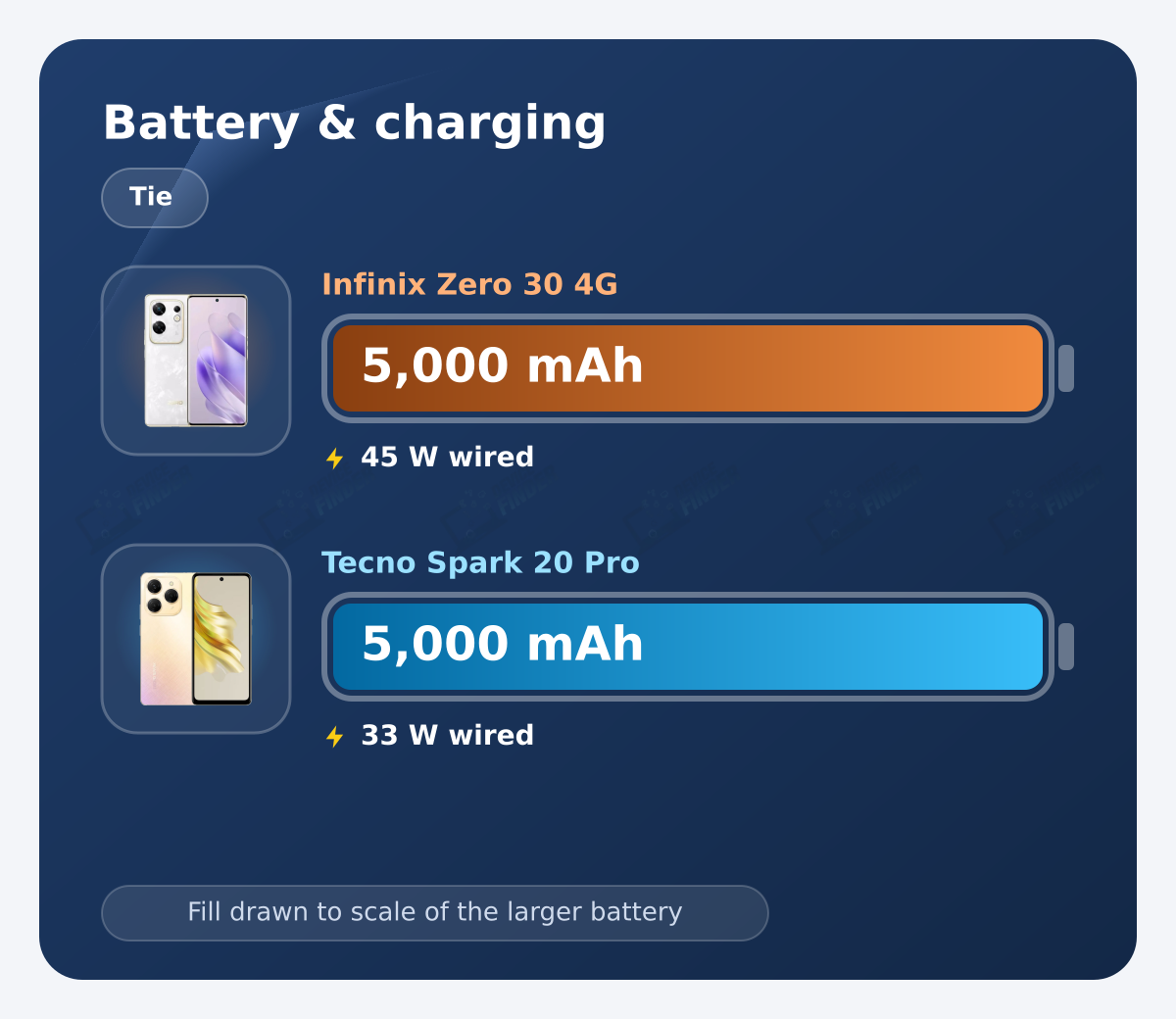
The two phones each hold 5,000 mAh. The Zero 30 4G charges faster by cable at up to 45W, while the Spark 20 Pro tops out at 33W.
75% in 30 minutes (45W wired) is the charging claim for the Zero 30 4G.
Same battery capacity on both phones
The two phones tie on battery, as the Zero 30 4G has 5,000 mAh and the Spark 20 Pro has 5,000 mAh. The Spark 20 Pro has a battery rating of 7.4, which is the score card's own score and not a spec.
Price and value: what each phone gives you
Each phone comes in 256GB storage.
UFS 2.2 is the storage type of the Zero 30 4G, and the two phones tie on storage. Buyers who want fast internal storage get that type listed on the Zero 30 4G.
Card slot supported is the listing for the Spark 20 Pro, while the Zero 30 4G has no card slot. Buyers who keep many videos on a card suit the Spark 20 Pro.
The Spark 20 Pro launched in December 2023, 1 month after the Zero 30 4G in October 2023. The two phones are close in age.
Storage and memory versions compared
The two phones tie on storage. The Spark 20 Pro has 4 GB + 256GB, 8 GB + 256GB and 12 GB + 256GB versions. The Zero 30 4G has the single 8 GB + 256 GB version.
What each phone includes
AMOLED on the Zero 30 4G comes with its camera win and its charging win, so it suits buyers who shoot and charge often. The Spark 20 Pro adds RAM versions and a 3.5mm headphone jack supported, so it suits buyers who use wired earphones. Buyers who care most about the screen and the camera should lean to the Zero 30 4G.
Infinix Zero 30 4G vs Tecno Spark 20 Pro: which phone to buy
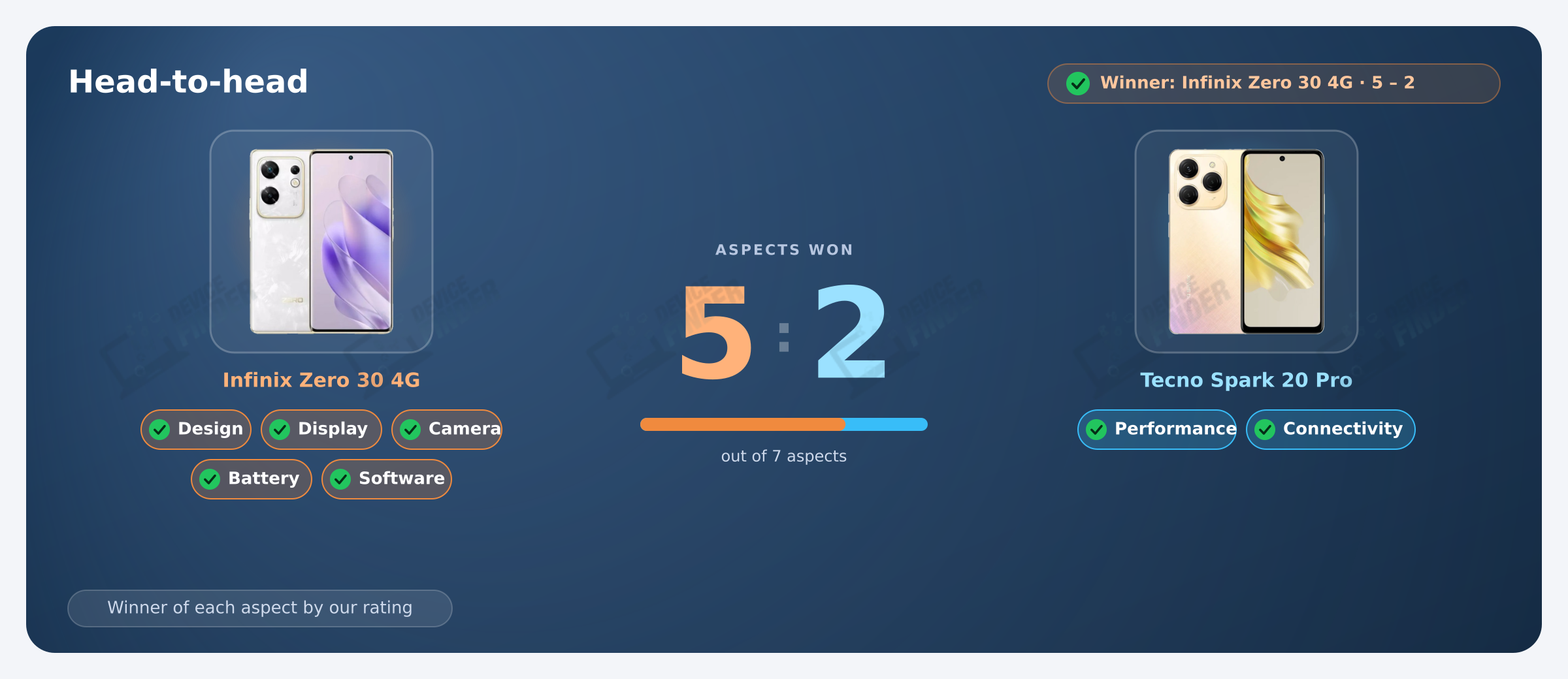
For most buyers in Bangladesh, choose the Zero 30 4G: it has a 50 MP selfie camera, 45W wired charging and an f/1.7 wide lens. The Spark 20 Pro suits buyers who want a RAM choice, since it comes in 4GB, 8GB or 12GB. Buyers who store videos on a card give up that option on the Zero 30 4G, which has no card slot.
Both phones hold 5,000 mAh, so the choice rests on charging speed and camera, not capacity. The Zero 30 4G fits buyers who shoot and charge often, and the Spark 20 Pro fits buyers who want a card slot and a headphone jack.
Read the full review of each phone: Infinix Zero 30 4G, Tecno Spark 20 Pro.
Related pages
DevicesFinder.com Score: Zero 30 4G vs Spark 20 Pro
Each category is scored out of 10. The stronger colour marks the winner. Ties are shown with both bars in the strong colour.
Zero 30 4G vs Spark 20 Pro Specifications Comparison
 Zero 30 4GFull specs
 Spark 20 ProFull specs
Display
General
Network
Additional Features
Audio
Battery
Body
Connectivity
Front Camera
Main Camera
Memory
Performance
Platform
Sensors
How I test
I compared both phones on their full specification sheets. Neither phone has a benchmark score on its sheet, so I make no benchmark comparison. No shop in Bangladesh lists a price for either phone, so there is no price comparison. The category winners in the text come from the values on those specification sheets.
Last updated
This is our own independent analysis and the author's view. Before buying any product, check its specifications, price, warranty and quality yourself. We do not guarantee that the information on this page is 100% accurate or up to date. Read more
Frequently asked questions
Which is better, the Zero 30 4G or the Spark 20 Pro?
Which has the better camera, Infinix Zero 30 4G or Tecno Spark 20 Pro?
Do the Infinix Zero 30 4G and Tecno Spark 20 Pro use the same processor?
Which phone charges faster, Infinix Zero 30 4G or Tecno Spark 20 Pro?
Does the Tecno Spark 20 Pro have a memory card slot?
Which phone has an AMOLED display?
Is the Infinix Zero 30 4G or Tecno Spark 20 Pro water resistant?
About the author

User Review for Comparison of Infinix Zero 30 4G vs Tecno Spark 20 Pro
Did this comparison help you choose? Rate it and tell other readers what decided it for you.