
When you search for LCD display definition, your intention is clear. You want a simple, factual, and reliable explanation. You want to understand what an LCD display is, how it works, where it's used, and why it remains important today.
Having spent more than 18 years working closely with mobile displays and screen technologies, I can confidently say that LCD has been one of the most consistent, dependable, and widely adopted display technologies throughout this time. Despite the rise of newer display types, LCD continues to play a crucial role across many industries.
In this article, you will find a clear and complete explanation that covers everything you need to know about LCD displays, from the basic definition to real-world applications, helping you fully understand the technology and satisfy your curiosity.
Table of contents: LCD Display Definition
-
Overview
-
What Is the LCD Display Definition?
-
Why LCD Displays Do Not Produce Their Own Light
-
How an LCD Display Works Step by Step
-
Internal Structure of an LCD Panel Explained Simply
-
Types of LCD Display Technologies
-
Where LCD Displays Are Used in Daily Life
-
Advantages of LCD Displays
-
Limitations of LCD Display Technology
-
LCD Compared With Newer Display Technologies
-
Why LCD Displays Remain Popular in Bangladesh
-
Resolution and Image Quality in LCD Displays
-
Color Accuracy and Viewing Angles
-
Durability and Lifespan of LCD Displays
-
Future of LCD Display Technology
-
Final Explanation of the LCD Display Definition
-
FAQs About LCD Display Definition
What Is the LCD Display Definition?
LCD display definition refers to a flat panel display technology that uses liquid crystals to control light and form images. LCD stands for Liquid Crystal Display. LCD does not emit light on its own. Instead, it relies on an external light source.
Liquid crystals sit between layers of glass and polarizing filters. When an electrical voltage is applied, these crystals change alignment. This alignment controls how much light passes through each pixel. The controlled light then forms text, images, and video on the screen.
From long-term professional use, this is why LCD displays feel stable and comfortable. The light source stays constant, and only the image information changes.
Why LCD Displays Do Not Produce Their Own Light
A key technical point explained by Wikipedia and the Lenovo Glossary is that LCDs are non-emissive displays. Liquid crystals cannot generate light on their own; they only block or allow light to pass. Because of this, every LCD panel requires a backlight unit. Older LCDs used CCFL backlights, while modern LCDs rely on LED backlights, which are thinner and more energy-efficient. This design leads to two common traits: good power efficiency and blacks that are not perfectly black, since the backlight is always on.
In contrast, Super AMOLED displays are emissive. Each pixel produces its own light and can turn off completely, resulting in true blacks, higher contrast ratios, thinner panels, and improved power savings when displaying dark content.
How an LCD Display Works Step by Step
According to Electronics For You and CDTech LCD, the working process of an LCD display follows a precise layered system.
Light starts from the LED backlight at the rear of the panel. This light passes through diffusion sheets that spread brightness evenly. Next, the light goes through a polarizing filter, which aligns light waves in one direction.
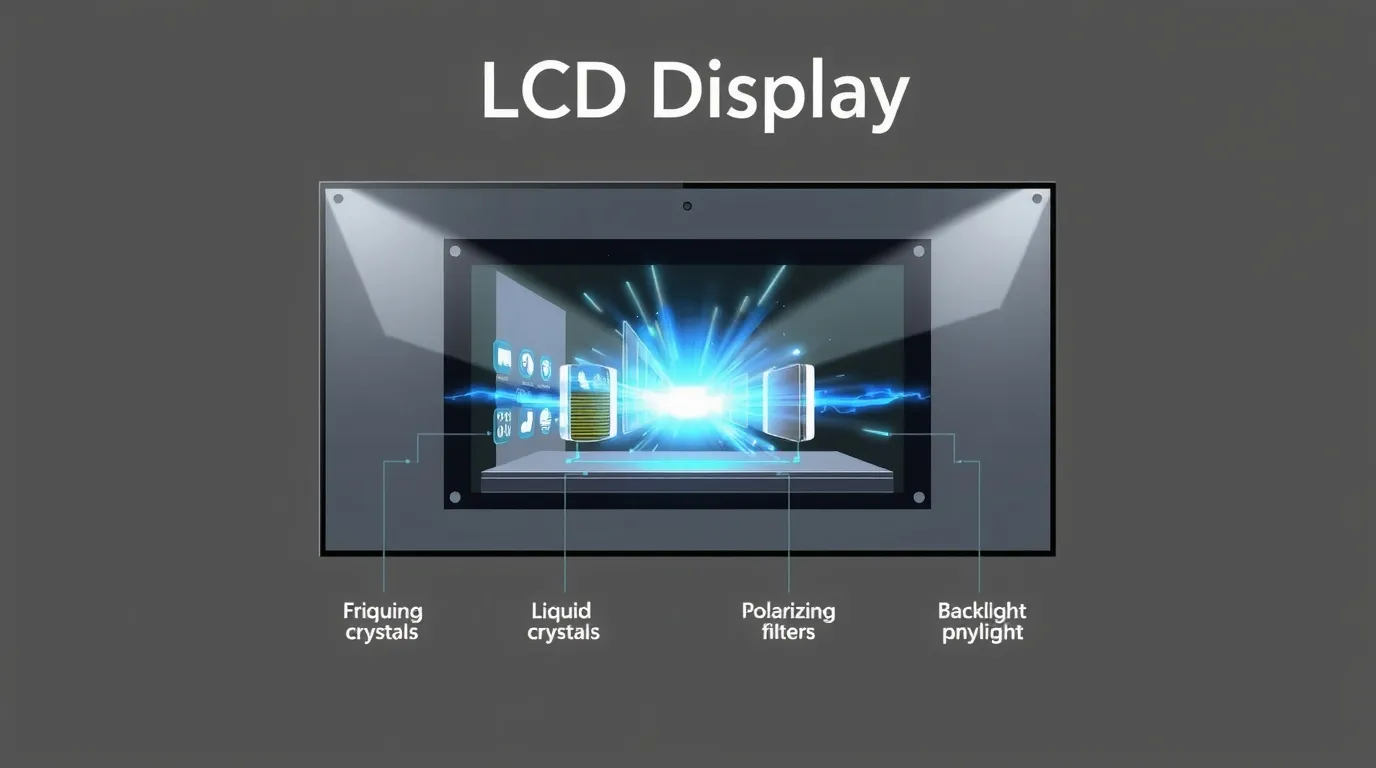
The light then reaches the liquid crystal layer. Electrical signals control how the crystals twist. This twisting determines how much light can pass through. After that, the light passes through a color filter layer that contains red, green, and blue sub-pixels. Finally, another polarizer allows the correctly modulated light to reach the viewer’s eyes as an image.
I have personally seen LCD panels opened in repair labs, and this structure matches exactly with what technical sources describe.
Internal Structure of an LCD Panel Explained Simply
CDTech LCD and Glomore explain that an LCD panel is made of multiple carefully aligned layers. At the back is the LED backlight. In front of it are light guide plates and diffusion films. Then comes the rear polarizer, followed by thin-film transistor electrodes. The liquid crystal layer sits between two glass substrates. On top of that is the color filter glass and the front polarizer.
Each pixel is divided into three sub-pixels. Red, green, and blue. By controlling these sub-pixels, the display produces millions of colors. This layered structure allows LCD panels to remain thin, light, and consistent in brightness.
Types of LCD Display Technologies
According to Wikipedia and Electronics For You, LCD displays are available in several panel types.
-
TN LCD panels are inexpensive and fast, but have poor viewing angles and color accuracy. They are often used in entry-level monitors.
-
IPS LCD panels offer wide viewing angles and accurate colors. This is why most smartphones, tablets, and laptops use IPS LCD technology today.
-
VA LCD panels focus on higher contrast and deeper blacks. They are commonly found on televisions.
-
STN and transflective LCDs are mainly used in calculators, industrial equipment, and outdoor displays.
From years of testing, IPS LCD provides the best balance for everyday use.
Where LCD Displays Are Used in Daily Life
LCDs are used in televisions, smartphones, laptops, desktop monitors, calculators, digital clocks, medical instruments, aircraft displays, and industrial control systems.

In Bangladesh, LCD screens are part of everyday life. Schools use LCD monitors and projectors for digital education. Offices rely on LCD displays for productivity. Hospitals use LCD screens for diagnostics. Homes use LCD TVs for entertainment. This wide adoption proves that LCD technology is reliable and practical.
Advantages of LCD Displays
Educational sources such as Vajiram and Ravi explain several advantages of LCD displays.
Lower power consumption: LCD displays consume significantly less power than older CRT displays, making them more energy efficient.
Thin and lightweight design: LCD technology allows screens to be slim and light, which helps manufacturers create portable devices like smartphones, laptops, and flat televisions.
Less heat generation: Compared to CRT technology, LCD displays produce much less heat, improving user comfort and device safety during long usage.
Affordable production cost: The manufacturing process of LCD displays is mature and well-established, which helps keep device prices affordable for consumers.
Comfortable for long viewing: From real-world experience, LCD displays are easy on the eyes. The stable backlight reduces visible flicker, making them suitable for long reading, studying, or office work sessions.
Limitations of LCD Display Technology
LCD displays have lower contrast than OLED-based displays. Black colors appear gray because the backlight cannot be turned off completely. Viewing angles are improved in IPS panels but still cannot fully match emissive displays.
These limitations explain why premium devices often highlight alternatives such as dynamic AMOLED, Dynamic AMOLED display Bangladesh, and Dynamic AMOLED 2X benefits. These technologies offer deeper blacks and higher contrast but come at a higher cost.
LCD Compared With Newer Display Technologies
LCD and AMOLED differ at a fundamental level. LCD uses a backlight. AMOLED pixels emit their own light. AMOLED offers true blacks and higher contrast. LCD offers better longevity, lower cost, and resistance to burn-in. This comparison is consistently explained in technical education materials. For many users, especially in budget-conscious markets, LCD remains the more practical choice.
Why LCD Displays Remain Popular in Bangladesh
In Bangladesh, affordability and durability are key buying factors. LCD displays deliver both. Most budget and mid-range smartphones use LCD panels. Educational institutions prefer LCD equipment due to cost efficiency. Repair costs are lower, and spare parts are widely available. Market observation shows that LCD-based devices continue to sell strongly because they meet real needs without unnecessary expense.
Resolution and Image Quality in LCD Displays
According to Wikipedia, Lenovo Glossary, and Electronics For You, resolution in LCD displays refers to the total number of pixels arranged horizontally and vertically, which directly determines image sharpness and clarity. Higher resolutions such as HD, Full HD, and 4K increase pixel density, resulting in clearer text and more detailed visuals.

Image quality also depends on panel technology (TN, IPS, VA), backlight uniformity, and color filter accuracy. Trusted sources confirm that IPS LCD panels provide better color consistency and wider viewing angles, while VA panels offer higher contrast, making resolution and panel type equally important for overall display quality.
Color Accuracy and Viewing Angles
Color accuracy and viewing angles in LCD displays depend mainly on panel technology. IPS (In-Plane Switching) LCD panels are known for accurate color reproduction and wide viewing angles, often reaching up to 178 degrees without noticeable color shifting. This makes IPS LCD suitable for professional work, media consumption, and shared viewing. TN LCD panels have limited viewing angles and weaker color accuracy, while VA LCD panels offer better contrast but slightly narrower viewing angles than IPS. These characteristics explain why modern smartphones, laptops, and monitors widely use IPS LCD technology for consistent visual quality.
Durability and Lifespan of LCD Displays
LCD displays are known for their long operational lifespan and stable performance. Because LCD panels use liquid crystals with a constant backlight, they are not affected by burn-in, a problem common in some OLED displays. Educational sources explain that a typical LCD display can last 30,000 to 60,000 hours, depending on backlight quality and usage conditions. LCDs also generate less heat, which reduces internal component stress over time. With proper care, such as avoiding excessive brightness, moisture, and extreme heat, LCD displays can remain functional for many years, making them reliable for long-term use.
Future of LCD Display Technology
According to Wikipedia, Electronics For You, Lenovo Glossary, and Vajiram and Ravi, LCD display technology continues to progress despite the growth of OLED. A major advancement is Mini-LED backlighting, which improves brightness control, contrast ratio, and local dimming while still using traditional LCD panels. IPS LCD technology is also evolving, offering higher refresh rates, improved color accuracy, and wider viewing angles.
Educational sources highlight that LCD manufacturing remains cost-effective, energy-efficient, and free from burn-in issues. Because of its long lifespan, stable performance, and affordable production, experts agree that LCD displays will continue to dominate mass-market TVs, monitors, laptops, and budget smartphones, particularly in developing markets like Bangladesh.
Final Explanation of the LCD Display Definition
The LCD display definition refers to a screen technology that uses liquid crystals to control light from a backlight and create images. LCD stands for Liquid Crystal Display. The display itself does not emit light. Instead, electrical signals adjust the alignment of liquid crystals to block or allow light through pixels. This process forms text, images, and videos on the screen.
LCD displays are thin, energy-efficient, reliable, and widely used in smartphones, televisions, laptops, monitors, and many everyday digital devices. Want clearer, trusted, and easy tech explanations like this? Stay with us and learn before you buy.
FAQs About LCD Display Definition
What is the LCD display definition in simple words?
The LCD display definition means a screen that uses liquid crystals to control light from a backlight and form images.
Does an LCD display produce its own light?
No. According to Wikipedia and Lenovo, LCD displays rely on a backlight because liquid crystals cannot emit light.
What are the main advantages of LCD displays?
LCD displays are energy efficient, thin, affordable, durable, and comfortable for long viewing sessions.
What is the difference between LCD and AMOLED displays?
LCD uses a backlight, while AMOLED pixels emit their own light. LCD offers better durability and lower cost.
Are LCD displays still relevant today?
Yes. Due to affordability, reliability, and continuous improvements, LCD displays remain widely used worldwide.


